
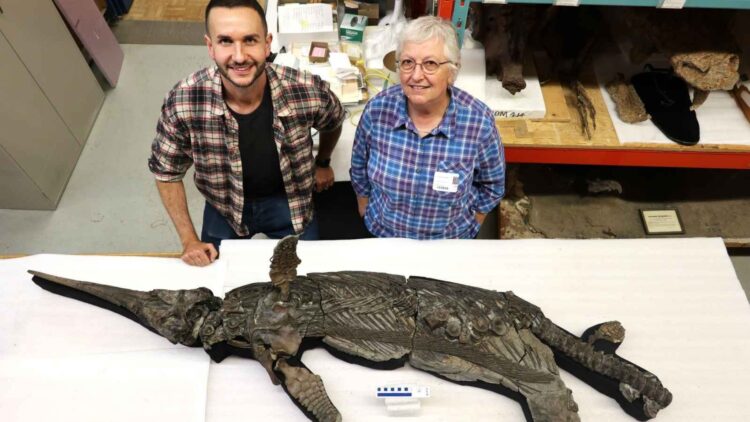
The cliffs of the Jurassic Coast of the United Kingdom, specifically between the towns of Charmouth and Seatown, have been, along with a local collector named Chris Moore, the protagonists of this story. In 2001, Moore found an almost complete ichthyosaur that shed light on one of the greatest mysteries in paleontology: the evolution of marine reptiles. After the discovery, the fossil became part of the collections at the Royal Ontario Museum, until a study was recently published in the journal Papers in Paleontology revealing its true significance and identity. It is none other than a new genus and species of ichthyosaur named Xiphodracon goldencapensis.
The article’s data reveal that Xiphodracon goldencapensis comes from the ‘Davoei Zone, Maculatum Subzone’ of the Charmouth Mudstone Formation, making it the most complete ichthyosaur known from that geological stage. Its anatomical features are not found in any other ichthyosaur from the Early Jurassic, making it a unique specimen and shedding light on its evolutionary position within the Leptonectidae group. According to phylogenetic analyses, it is related to the genus Hauffiopteryx, forming with it a new clade called Hauffiopterygia. This data allows the animal to be placed at a turning point between the marine faunas of the Sinemurian and those of the Toarcian.
In addition to all this information, the fossil also showed fractures in the skull indicating that this was the cause of its death, and it is believed that the only species that could be responsible is an individual of the ichthyosaur Temnodontosaurus. The possibility of filling this gap in the timeless line of marine evolution within paleontology has been made possible not only by Moore’s discovery, but also by the collaborative work of researchers Dean Lomax, Judy Massare, and Erin Maxwell.
Discovery on the British coasts
One of the most significant discoveries for paleontology and evolution took place in 2001 on the cliffs of the Jurassic Coast of the United Kingdom, specifically between Charmouth and Seatown. It was then that collector Chris Moore found an almost complete fossil, which without investigation became part of the collections of the Royal Ontario Museum. It is only recently that the relevant study and analysis have been carried out, which has been published in the journal Papers in Paleontology, and which has shed light on a marine evolution episode about which there was barely any data. It is a new genus and species of ichthyosaur named Xiphodracon goldencapensis, which has answered many previously unresolved questions.
Xiphodracon goldencapensis
Analyses have revealed that the specimen belongs to the Pliensbachian, a period following the Hettangian and Sinemurian, to which the rest of the ichthyosaurs found in Europe belong. The article notes that Xiphodracon goldencapensis comes from the “Davoei Zone, Maculatum Subzone” of the Charmouth Mudstone Formation, making it the most complete ichthyosaur known from that geological stage.
The anatomical features studied have not been seen in any other specimen, with a jaw forming the lower edge of the external naris and a lacrimal with projections similar to those on its inner edge. These features make it possible to place it on the evolutionary line within the group Leptonectidae. On the other hand, phylogenetic analyses relate Xiphodracon to Hauffiopteryx, forming a new clade called Hauffiopterygia. It is thanks to this that it can be determined that the animal is among the marine faunas of the Sinemurian and those of the Toarcian.
Importance of the discovery
According to the study, the Xiphodracon is “more closely related to species from the late Early Jurassic than to earlier genera that continued into the Pliensbachian,” which opens the possibility that the faunal change that separates the Sinemurian from the Toarcian may have begun earlier than previously thought, specifically in the middle or late part of the Pliensbachian. The importance of this fossil is related to its good state of preservation and its size, which have made this analysis possible, as well as the extraction of new conclusions that change what was previously believed about the transitions between historical periods in paleontology.