
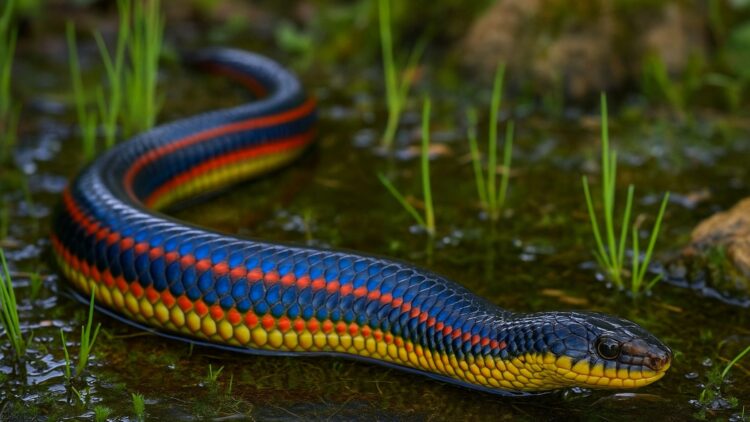
The Florida Fish and Wildlife Conservation Commission (FWC) has raised alarms and has requested citizen collaboration to find specimens of one of the most colorful snake species, the Farancia erytrogramma, more commonly known as the rainbow snake. We must go back to 2020 to talk about the last revival, so the authorities are asking for collaboration to find and preserve this endangered species. It is a non-venomous species that used to inhabit the Panhandle and the northern part of the Florida peninsula.
Specifically, in the St. Marys and St. Johns rivers and Suwannee. The Florida Museum has also added that it can be found in springs and lakes, and in Fisheating Creek, Glades County, although there has been no record there since 1952. The Fish and Wildlife Research Institute explains that the main threats to this species include the decline of the American eel, its primary prey.
This species is commonly confused with the Red-bellied Mudsnake (Farancia abacura) and the Black Swampsnake (Liodytes pygaea). Therefore, in case you see one, authorities advise taking a picture as long as it is safe, not to handle the animal, and to report the sighting using the FWC Reports app or on the official FWC website.
Rainbow snake (Farancia erytrogramma)
Rainbow snake is the common name for the non-venomous aquatic snake Farancia erytogramma. It is a native species from the southeastern United States, specifically Florida. Its appearance is truly striking, as it has black or violet-blue scales with iridescent reflections in the sun, three red stripes on its back, and a chin with yellow scales and purple spots. Although a specimen of 173 cm has been recorded, its standard size is between 70 and 122 cm in length.
It is not dangerous, but when it feels threatened, it releases a musky odor by pressing the tip of its tail. The births of this species usually occur between the months of September and October, with females laying between 10 and 52 eggs per season.
Where is the rainbow snake commonly found?
Records of specimens of this species locate it in the following areas:In the Panhandle and the northern part of the Florida Peninsula.The basin of the St. Mary, St. Johns, and Suwannee rivers.Springs, brackish marshes, lakes, and cypress swamps, according to the Florida Museum.On riverbanks, logs, floating vegetation, and Spanish moss.In Glades County, at Fisheating Creek, although there have been no records from that area since 1952.
What factors are threatening its survival?
From the Fish and Wildlife Research Institute, it is explained that the main causes of the possible extinction of the species are:
- The disappearance of its habitats, the aquatic ecosystems.
- The decrease of its main prey: the American eel.
- The high dependency on the eel.
What should I do if I come across a rainbow snake?
From the Florida Fish and Wildlife Conservation Commission (FWC) and the Fish and Wildlife Research Institute, citizen collaboration is essential to locate specimens of this species in order to preserve it and save it from extinction. Therefore, if you encounter a specimen, the relevant authorities recommend:
- Take a photo of the specimen, only if it is safe to do so.
- Under no circumstances touch, move, or handle the animal.
- Report the sighting through the FWC Reporter app or on their official website.
The FWC is making this call and reminds citizens that their actions could help prevent this species, which is part of Florida’s Natural Heritage, from becoming extinct.
Have you heard of the Shoebill bird, which could be on the brink of extinction in Africa?