
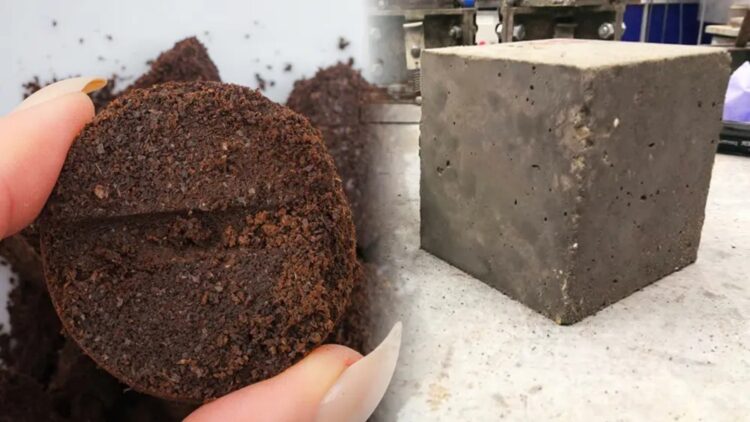
A group of scientists from RMIT University, led by engineer Rajeev Roychand, decided to find a use for the 10 billion kilograms (22 billion pounds) of coffee waste that ended up in landfills. After their study, they were able to determine that charred coffee beans could increase concrete strength by 30%. According to RMIT engineer Jie Li, the environment is affected by the large amount of natural sand extraction worldwide required for construction, so introducing coffee waste as part of the cycle seemed like an idea that would help reduce the impact of sand mining and its methane emissions on climate change.
When subjected to temperatures of 350ºC (660ºF), a process called pyrolysis, the organic molecules in the coffee waste break down, producing a porous, carbon-rich charcoal called biochar, which can be incorporated into cement. Shannon Kilmartin-Lynch, an engineer at RMIT, explained that the next step is to subject the coffee-cement hybrid to cycles of freezing and thawing, abrasions, and other stress factors. The research is still in its early stages, but according to the researchers, the findings are promising, generating an alternative that reduces the amount of organic waste that ends up in the landfill.
Climate risks of organic waste
Did you know that every year around 10,000 million kilograms (22,000 million pounds) of coffee waste are produced worldwide? And the worst part is that the vast majority ends up in landfills, which is a real environmental problem. As explained by RMIT University engineer Rajeev Roychand when the research was published in 2023, “The disposal of organic waste poses an environmental challenge as it emits large amounts of greenhouse gases, including methane and carbon dioxide, which contribute to climate change. The problem is not only in the combustion of organic waste without environmental impact, but also in the global boom of the construction market”
“This exposes the planet to other environmental challenges, such as the extraction of natural resources. Jie Li, an engineer at RMIT, explains that “The continuous extraction of natural sand worldwide—typically taken from riverbeds and banks—to meet the rapidly growing demands of the construction industry has a significant impact on the environment. Maintaining a sustainable supply of sand poses critical and enduring challenges due to the finite nature of the resources and the environmental effects of sand extraction. With a circular economy approach, we could keep organic waste out of landfills and also better preserve our natural resources, such as sand”, he added.
How can coffee waste be utilized?
The truth is that organic products cannot be added directly to the cement mixture, as the leaching of chemicals would weaken the material’s strength in construction. That is why researchers subjected coffee waste to temperatures above 350ºC (660ºF) while depriving it of oxygen, in a process called pyrolysis. This method decomposes the organic molecules, resulting in a carbon called biochar, which is porous and rich in carbon and can form bonds and be incorporated into the cement matrix.
According to Shannon Kilmartin-Lynch, an engineer at RMIT, “Our research is in the early stages, but these interesting findings offer an innovative way to significantly reduce the amount of organic waste going to the landfill.” The next step in the research is to test how the coffee-cement hybrid performs under stress factors such as freezing, thawing, abrasion, or water absorption. Additionally, they also aim to develop biocarbons from other sources of organic waste, such as wood, agriculture, or food. Kilmartin-Lynch added, “The inspiration for my research, from an Indigenous perspective, involves caring for the land, ensuring a sustainable life cycle for all materials and preventing things from ending up in the landfill to minimize environmental impact.”