
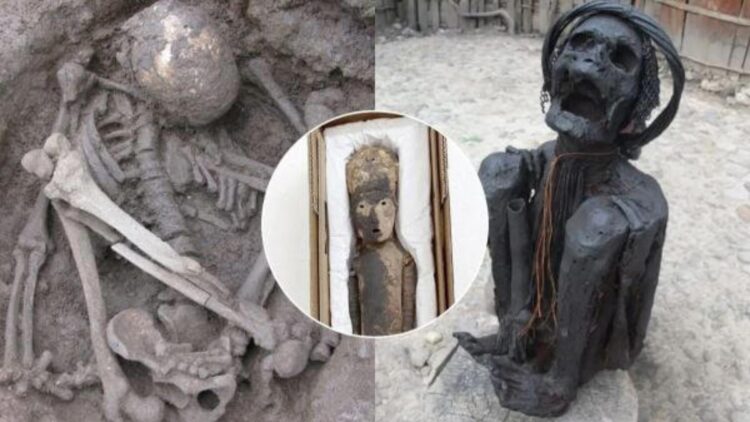
When we think of mummies, our collective imagination immediately takes us to Egypt, right? However, recent discoveries are forcing us to revise and expand this concept, as Egypt’s 4,500-year-old mummies have been dethroned. The article published in the journal Proceedings of the National Academy of Sciences shows the study carried out by archaeologists from different parts of the world, who have found mummies between 4,000 and 14,000 years old in southern China and Southeast Asia, as explained by the study’s co-author and professor emeritus of archaeology at the Australian National University in Canberra, Peter Bellwood.
The sample consisted of remains from 54 pre-Neolithic burials at 11 different archaeological sites in Vietnam, the Guangxi Zhuang Autonomous Region of China, the Philippines, Laos, Thailand, Malaysia, and Indonesia. It was Bellwood who also explained that this was a population of hunter-gatherers who inhabited Southeast Asia but spread to places such as Australia and New Guinea. Furthermore, the fact that the oldest mummies belong to Egypt is another collective error, as they are from Peru and Chile, belonging to a fishing people from 7,000 years ago, the Chinchorro.
Salima Ikram, professor of Egyptology at the American University in Cairo, explained in an interview that this concept of mummification has been used by different civilizations for the same purpose: to preserve the body. A project that began in 2017 and now has 24 experts covering different lines of research with apparently positive results, as indicated by the study’s lead author, Hsiao-chun Hung.
Mummies beyond Egypt
From now on, when we think of mummies, we will have to change our concept and broaden our understanding and knowledge of them. What was once directly related to Egypt is now related to many more regions, where civilizations that once existed also used mummification to preserve the bodies of their deceased. In fact, the oldest mummies found to date do not belong to Egypt, but to Peru and Chile, where they belonged to a fishing people from 7,000 years ago, the Chinchorro.
Discovery of mummies in China
An article in the journal Proceedings of the National Academy of Science reported on a study carried out by archaeologists from different regions, who analyzed the remains of 54 pre-Neolithic burials from 11 different archaeological sites, including southern China, Southeast Asia, Vietnam, the Guangxi Zhuang Autonomous Region of China, the Philippines, Laos, Thailand, Malaysia, and Indonesia. According to Peter Bellwood, professor emeritus of archaeology at the Australian National University in Canberra, “We found that in southern China and Southeast Asia, there were many archaeological sites containing human burials dating from between 4,000 and 14,000 years ago”.
The human remains found there shared the same position: the body reclining or crouching, with traces of burns. Researchers concluded that prior to burial, the remains had been smoked with fire for a period of time as part of the mummification process. According to Bellwood, “they belong to an original population of hunter-gatherers who occupied Southeast Asia in Paleolithic times and continued their occupation in places such as Australia and New Guinea until the present day”.
Research continues and supports the hypotheses
The study’s lead author, Hsiao-chun Hung, said in an email statement, “We have gradually gathered multiple lines of evidence over many years. It’s a bit like detective work—finding small clues, piecing them together, and becoming increasingly confident in the hypothesis.” This study began in 2017 as a casual conversation between two of its authors, but it subsequently took shape and incorporated 24 experts in the field to contribute their knowledge and research.
Salima Ikram, a professor of Egyptology at the American University in Cairo who did not participate in the research, has also spoken out on the matter. Referring to the term mummification, she stated “The term has been adopted by other groups to identify other preserved bodies. Therefore, it now has a much more general understanding. The good thing is that the idea behind it is similar, because they wanted to preserve the body.”